
Coaching Was Never Meant to Stop at the C-Suite
Last week I asked you a simple question: who should be getting regular coaching at work?
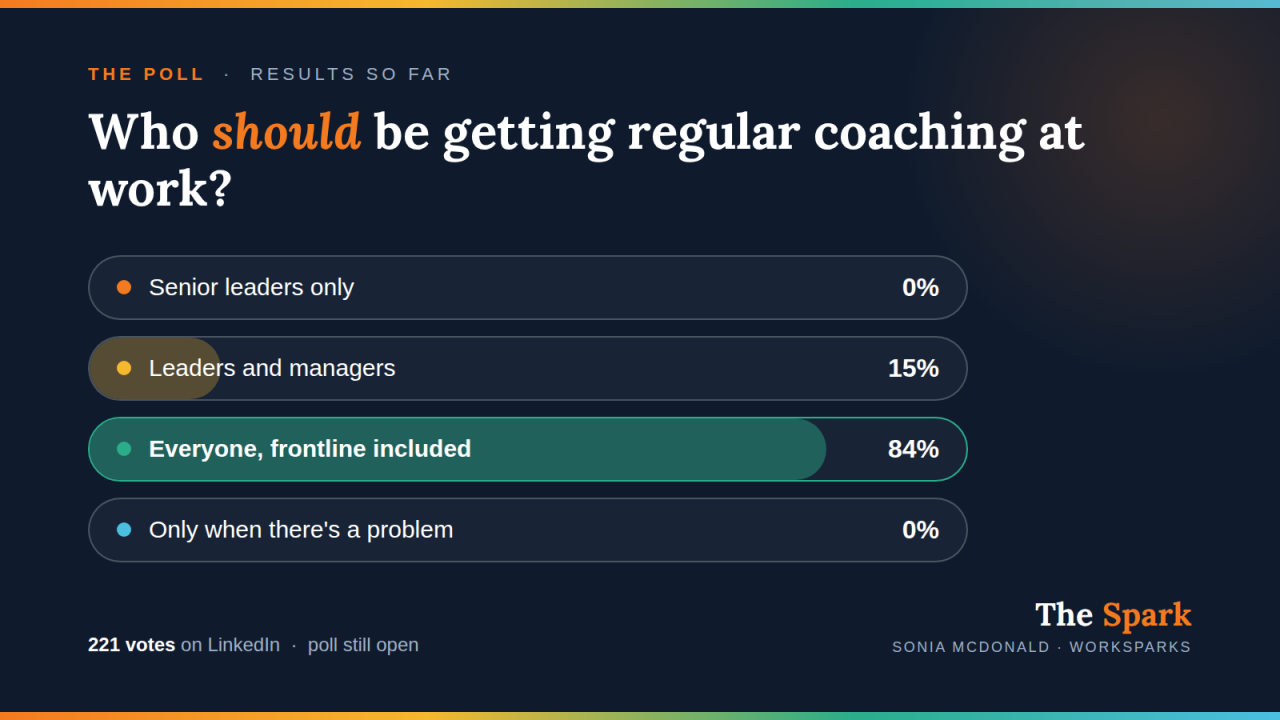
Of the 221 of you who voted, 84% said everyone, frontline included. Another 15% said leaders and managers. Vote here at https://lnkd.in/p/guV-Xess

And here’s the number I keep coming back to: not one person said senior leaders only. Zero.
Which is fascinating, because walk into almost any organisation and follow the coaching budget, and that’s exactly where it sits. At the top.
The executive team has a coach. The CEO might have two. Senior leaders get 360s, offsites and development plans. Then somewhere around middle management, the investment thins out. By the time you reach the frontline, it’s a two-day course, a slide deck and a “reach out if you need anything.”
So we have a strange situation. Almost nobody believes coaching should belong to the few. And yet that’s how most organisations still fund it.
That’s the gap I promised you. Let’s look at it properly.
✦ The Leadership Moment
She’d been a team leader for eight months. Promoted from the floor because she was brilliant at the job she used to do, the one everyone came to when something went wrong.
Now she was managing people who’d been her peers a year earlier. People she’d had Friday drinks with. People who’d seen her at her worst.
The night before, she was sitting at her kitchen table at 10pm, rehearsing a conversation she had to have at 7am. One of her team had been late four times in three weeks. Everyone had noticed. Everyone was waiting to see what she’d do.
She didn’t have a coach. Her executive team did. Her GM did. She had a Teams chat, a vague memory of a leadership module, and a knot in her stomach.
So she did what most new leaders do. She went in hard, because she was worried about looking soft. The conversation went sideways in four minutes. Her team member felt ambushed. Two others heard about it by lunchtime. And for the next month, the whole team felt a little more guarded around her.
None of that was a character flaw. It was a support gap.
Here’s what I know from the coaching room: the moment that mattered wasn’t the conversation. It was the night before. That’s where leadership actually happens, in the quiet, anxious space between knowing something needs to be said and saying it. And it’s exactly where most people are completely on their own.
✦ Why Coaching Got Stuck at the Top
It’s worth asking how we got here, because it wasn’t malicious. It was economics.
Traditional executive coaching is expensive. It’s one-to-one, it’s scheduled weeks in advance, and it relies on a skilled human being sitting across the table. When a resource is scarce and costly, organisations ration it, and they ration it towards the people whose decisions carry the most dollars.
That logic made sense on a spreadsheet. But it quietly built a story into our workplaces: coaching is for the important people. Over time, that story became a status symbol. Having a coach meant you’d made it.
The problem is that the “important decisions” logic only holds if you measure importance in dollars. Measure it in daily impact on people, and the picture flips completely.
✦ What the Research Says
Gallup’s global workplace data makes the case more clearly than I can:
• Managers are running on empty. Global manager engagement fell from 30% to 27%, while individual contributor engagement stayed flat at 18%. Engagement dropped five points for managers under 35, and seven points for female managers.
• And it hasn’t recovered. Between 2022 and 2025, the engagement gap between managers and the people they lead shrank from 11 points to just 3. Managers are now barely more engaged than their teams.
• Managers set the tone for everyone else. Managers account for 70% of the variance in team engagement, yet only 44% say they’ve received any formal training.
• Support works when people actually get it. Managers who receive training in good management practice are 22% more engaged, and their teams see an 18% lift in engagement.
Read those together and the picture is stark. The people with the biggest influence on how your teams feel every single day are among the least supported people in the building. And they’re getting more tired, not less.
Gallup also points to why: managers have been squeezed between new executive priorities and employee expectations. They’re translating strategy downward and absorbing frustration upward, often with no one in their corner.
Coaching the top and hoping it trickles down isn’t a strategy. It’s a habit we never questioned.
✦ What Changes When Everyone Has Support
When I talk about coaching “everyone,” people often picture every employee getting a weekly hour with an executive coach. That’s not realistic, and honestly, it’s not what most people need.
It’s also worth noticing that not one of you voted for “only when there’s a problem.” You already know coaching works best as everyday support, not an emergency intervention once something has gone wrong.
What people need is smaller and more frequent:
• Support in the moment, not three weeks later in a debrief. The night before the hard conversation. The ten minutes after a meeting that went badly.
• A thinking partner, not an answer machine. Someone, or something, that asks the right question so they can find their own way through.
• Practice before performance. A chance to rehearse the difficult thing in a safe space before doing it for real.
• Consistency. Small nudges, repeated often, change behaviour far more than one big intervention a year.
When frontline leaders get that kind of support, the ripple effect is enormous. Better conversations. Fewer escalations. Less of the quiet disengagement that never shows up in a report but everyone feels in the room.
And the executive team benefits too. When the layers below them are leading well, they stop spending their days cleaning up.
✦ Your Micro-Tool: The Night-Before Check
Before any tough conversation, take two minutes and answer three questions:
1. What do I actually need from this conversation? One outcome, not five. If you walk in trying to fix everything, you’ll fix nothing.
2. What’s the story I’m telling myself about this person? “They don’t care.” “They’re testing me.” Notice the story, then ask whether it’s fair. Often it’s our anxiety talking, not the evidence.
3. What’s the first sentence I’ll say? Write it down. The first line sets the whole temperature. “I’ve noticed you’ve been late a few times and I wanted to check in” lands very differently from “We need to talk about your lateness.”
Then one bonus step: decide how you want them to feel when they walk out. Not whether they agree with you. How they feel. Respected? Heard? Clear on what happens next? Lead with that in mind.
It sounds small. It’s the difference between reacting and leading.
✦ The Spark Question
Who in your organisation is making the most leadership decisions, with the least support?
Sit with that one. Picture them. The team leader on the late shift. The newly promoted manager who hasn’t been told what good looks like. The supervisor holding a stretched team together with goodwill and caffeine.
Then ask yourself: what would it take to change that? And what’s it costing you not to?
This is why we built Worksparks.

I spent years watching brilliant people struggle in the exact moments that mattered, simply because support was rationed by title. Worksparks exists to change that.
It puts real-time leadership coaching in the hands of every leader, from the executive team to the person who got promoted last month. Built on the behavioural and neuroscience frameworks we’ve used with leaders for years, it’s there the night before the hard conversation, not three weeks after it.
84% of you already believe coaching should reach everyone. Not one of you said it should stay at the top. Worksparks is how you make that belief real.
Coaching shouldn’t be a perk for the few. It should be how work works.
See why in 7 days. Try Worksparks free → https://worksparks.com/
Sonia
Sources
Gallup, Global Employee Engagement Continues Decline (2026)
People Results, Gallup State of the Global Workplace 2026
Inspiring Workplaces / Gallup, Global Employee Engagement Falls Again (2025)
Mo, Gallup’s State of the Global Workplace 2025: Key Insights
Stylus, Gallup State of the Workplace 2025