The work is rarely the hard part. The people are.
Every team carries conversations nobody’s having. The feedback that never quite lands. The tension nobody names. The person who’s gone quiet. Worksparks gives everyone somewhere private to work it out before it becomes the team’s problem.
Teams don't break in the meeting. They break in the six weeks before it.
Most of what makes a team hard to be in is invisible. Someone decides not to say the thing. Someone else reads it the wrong way. A small resentment gets carried around for a month because there was never a good moment, and by the time there is one it’s too big to raise casually.
None of that shows up in a project plan. It shows up later, as a resignation, a complaint, or a team that quietly stops telling each other the truth.
The usual answer is to send the manager on a course. But the manager isn’t the only one holding something and a course six months ago doesn’t help with the conversation that’s needed on Thursday.
Worksparks sits with each person in the moment they’re actually stuck.
The things nobody puts in an email.
Not just the manager’s problems. Everyone’s.
A peer whose work keeps landing on your desk half-finished. No authority to raise it, and every version in your head sounds like a complaint.
Five minutes, on their own, before it gets harder.
Everyone on the team gets their own private coach. It doesn’t tell them what to do it helps them work out what they think, with the structure a good coach would use.
Describe what’s actually happening, without editing it into something presentable. The messier the truth, the more useful this gets.
You'll know it's working. You'll never know what anyone wrote.
A team tool that reports on people isn’t a coaching tool, it’s a monitoring tool and nobody is honest inside one. So the line is drawn hard, and it’s drawn in the product, not in a policy document.
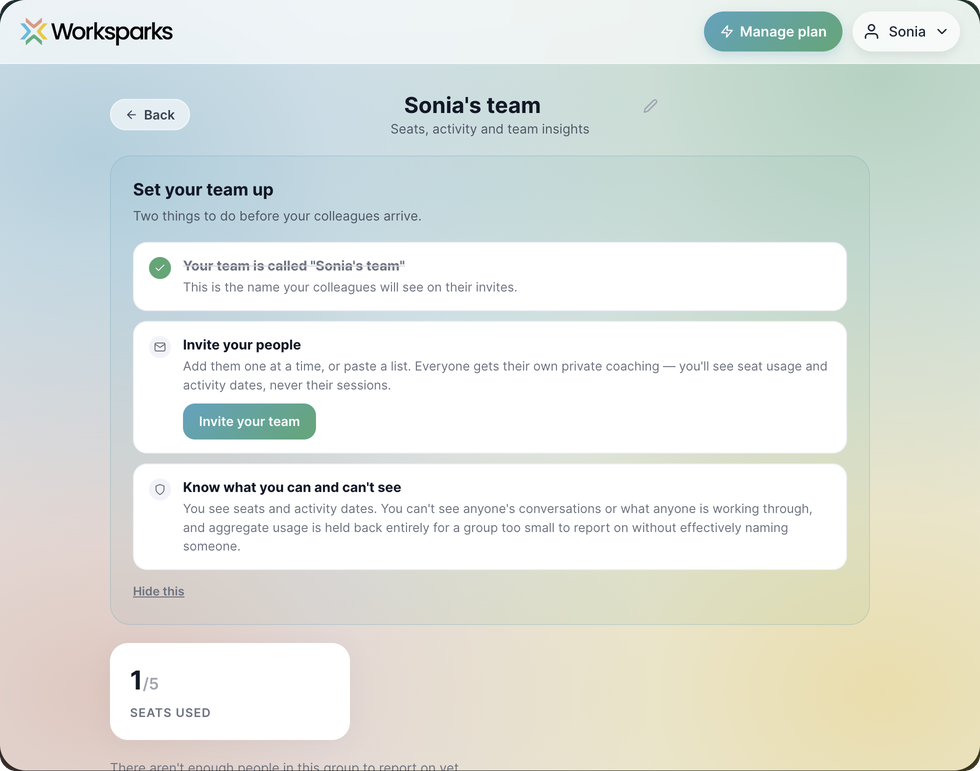
What the dashboard shows
- Who has a seat and whether they've activated it, so you're not paying for licences nobody opened.
- How much the team is using it sessions across the group, over time. As a number, not a leaderboard.
- Themes, once you're at ten people or more. The patterns coming up across the team, aggregated. Below ten, a group is too small to anonymise properly, so themes stay switched off.
What it never shows
- Anything anyone wrote. Not to you, not to HR, not to anyone. There is no screen where that exists.
- Who said what. Themes are never traceable back to a person, which is exactly why they need ten people to work.
- Scores, ratings or rankings. Nothing that could end up in a performance conversation.
Under A$33 a person a month.
- Everything in Individual, for every person on the team
- Shared scenarios built around how your team actually works
- Team dashboard Seats and usage from day one. Themes from ten people up.
- Onboarding support to get the team actually using it
Somebody on your team is stuck on something right now.
More than fifty people? See Worksparks for organisations