
I need your help…
The best coaching your people will ever get won’t happen in a workshop. It will happen on an ordinary Tuesday, in the five minutes after a meeting goes sideways.
I’ve spent 35 years working with leaders, and I keep seeing the same moment play out. A manager walks out of a tough conversation, or into one they’ve been dreading. They have a team member who has gone quiet, a decision that won’t sit still, or feedback they don’t know how to give. They need help right then. And right then, they’re on their own.
We’ve built an entire industry around leadership development, and much of it is brilliant. But most of it arrives in scheduled blocks, a few times a year, for a handful of people. Leadership doesn’t work on that timetable. It happens in the gaps between the programs.
Why coaching beats telling
Telling is fast. Coaching is what lasts. When you tell someone what to do, you solve today’s problem and teach them to bring you tomorrow’s. When you coach, you help them think it through, so the next time they can do it without you. That’s how capability grows across a team instead of piling up on one desk.
Coaching also builds the things every organisation says it wants: ownership, confidence, trust and people who speak up. People back the plans they helped create.
Here’s the catch. In most organisations, real coaching is a privilege of seniority. Executives get a coach, and everyone else gets a course. Yet the people who need support most often are the new team leader promoted for being good at the job, the manager stretched across too many direct reports, and the person who has never been shown what good looks like.
If coaching only reaches the top, most of your organisation is learning leadership by trial and error. Usually that means error.
Eight ways to coach your team, starting this week
You don’t need a qualification or a spare afternoon to coach. You need a few habits you can use in everyday moments. Here are the ones I come back to again and again.
1. Ask before you answer
When someone brings you a problem, resist the urge to fix it. Start with a question: “What have you tried so far?” or “What do you think the options are?” You’ll be surprised how often they already know. Your job is to help them find it.
2. Make “What’s really going on?” your favourite question
The first problem people raise is rarely the real one. “I can’t get this report done” might mean “I don’t understand what’s expected” or “I’m overwhelmed and too scared to say so.” Ask once, then ask again. The second answer is usually the one that matters.
3. Coach in the moment, not just in the review
Feedback saved for a quarterly conversation is feedback that arrives too late. The most powerful coaching happens within hours of something happening, while it’s still fresh. Five minutes after a meeting beats an hour three months later.
4. Get specific
“Great job” feels nice and teaches nothing. “The way you summarised the client’s concerns before giving our view calmed the whole room” tells someone exactly what to repeat. The same goes for tough feedback: describe the behaviour and its impact, not the person.
5. Listen to understand, not to reply
Most of us listen while rehearsing what we’ll say next. Try this: before you respond, reflect back what you heard. “So the deadline isn’t the issue, it’s that you weren’t consulted?” People who feel heard open up. People who feel managed shut down.
6. Let them own the next step
End every coaching conversation with a commitment that belongs to them. “What will you do, and by when?” works far better than “Here’s what you need to do.” Then follow up. Accountability without follow-up is just a nice chat.
7. Coach the whole person
People don’t leave their lives at the door. Stress, confidence, caring responsibilities and the way someone’s brain works all shape how they show up. Neurodivergent team members, for example, often need different approaches to feedback, focus and communication. Great coaching meets people where they are.
8. Make it safe to say “I don’t know”
None of this works if people are afraid to be honest. Go first. Share a mistake you made and what you learnt. Thank people for raising problems early. When a team learns that honesty is rewarded, coaching stops being an event and becomes the way you work.
The gap no workshop can fill
These habits work. But even the best leaders can’t be there for every person at every moment. Managers are stretched, HR teams are lean, and a human coach for everyone is out of reach for almost every organisation.

That’s the gap I set out to close with Worksparks .
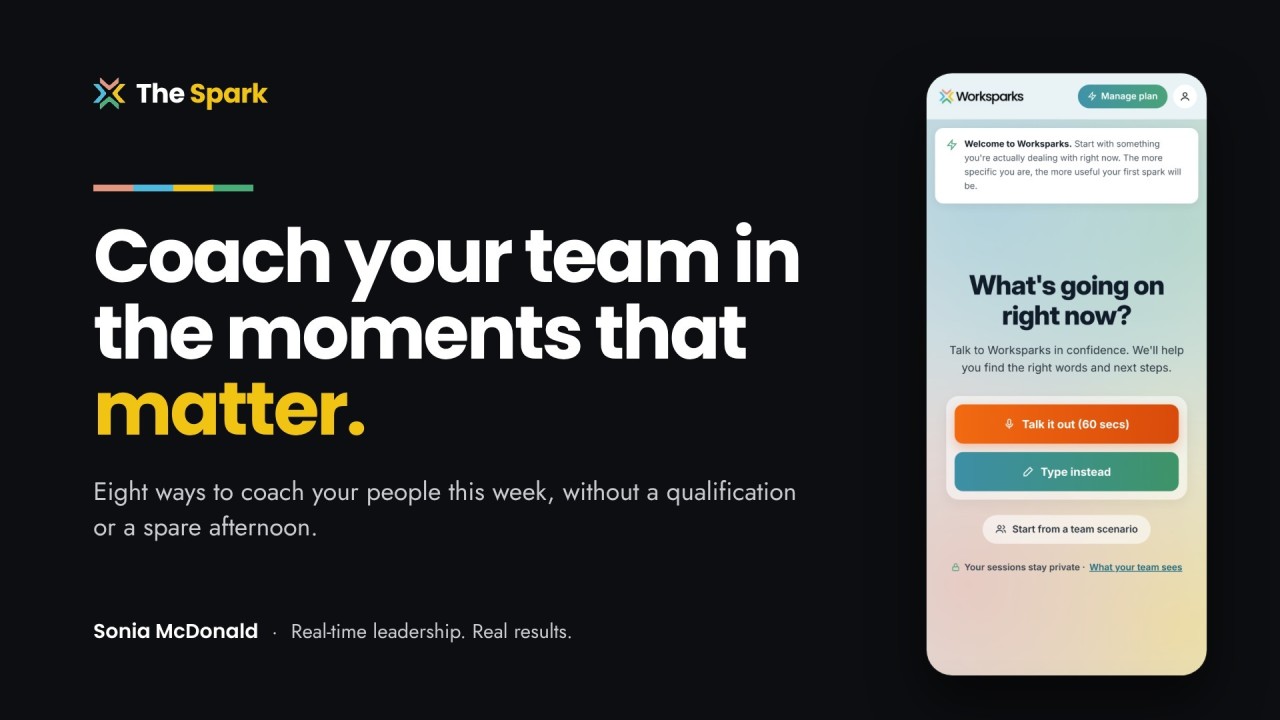
Worksparks is an AI-powered leadership coach for everyone at work, not just the people at the top. It’s there in the moment: before the hard conversation, after the meeting that went wrong, or at midnight when a decision won’t let you sleep. You can talk it through or type it out, and in a few minutes you have the right words and a clear next step. No booking. No waiting until next Thursday.
It isn’t a generic chatbot. It’s built on the human leadership frameworks I’ve developed and tested with real leaders over my career. It coaches the way a good coach does: it asks questions, helps people think, and leaves them owning the next step. Individual sessions stay private, and team leaders see only aggregate insights.
I don’t believe technology replaces great leaders or great coaches. I believe it can make sure no one has to lead alone in the moments that matter most.
I need your help
If you work in HR or L&D, you know better than anyone what actually gets used inside an organisation and what gets ignored. You know what your people are asking for and where today’s tools fall short. That’s exactly the knowledge I need.
Worksparks is live, early adopters are already using it, and teams are piloting it now. What we build next is still being shaped, including development plans, culture and engagement insights and a dedicated L&D layer. I want HR and L&D leaders to help decide what comes first.
So I’m hosting a small online early-access session:
- When: Friday 30 October, 12pm AEST
- Where: Online via Microsoft Teams (the link is shared when you click Attend on the LinkedIn event)
- Who: HR and L&D leaders who care about growing leaders at every level
You’ll see Worksparks live, try it yourself and tell me honestly what’s missing and what would make it a must-have for your organisation. It won’t be a sales pitch. It will be a real conversation with people who care about this as much as I do.
Places are deliberately limited so every voice is heard. If you’ve ever thought there has to be a better way to develop your people, come and help me build it.
Register on the LinkedIn event →
Sonia McDonald is the founder of Worksparks and LeadershipHQ, an executive coach, keynote speaker and author of Leadership Attitude, Just Rock It! and First Comes Courage.